Physical AI is coming. here's why software builders should pay attention.
nvidia declared the "chatGPT moment for robotics is here." robotics raised $26.5 billion in 2025. the same agent architecture powering business workflows will power physical systems.
Feb 16, 2026
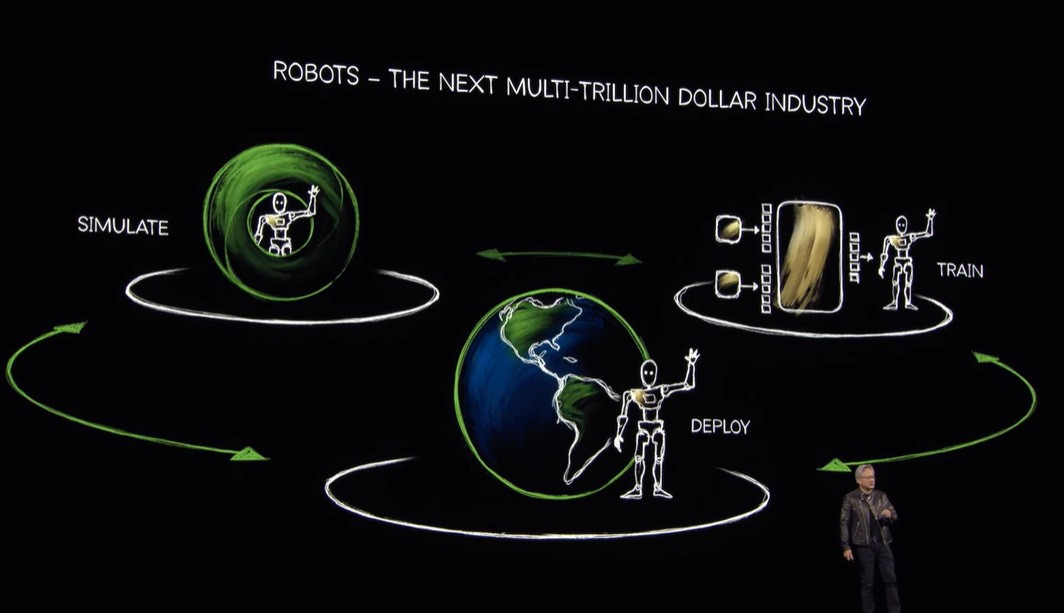
at CES 2026, nvidia CEO jensen huang declared that "the chatGPT moment for robotics is here". breakthroughs in physical AI, models that understand the real world, reason, and plan actions, are creating applications that didn't exist two years ago.
at davos three weeks later, he called robotics a "once-in-a-generation opportunity" and said AI has started "the largest infrastructure buildout in human history."
the numbers back it up. companies building robotics raised a record $26.5 billion in 2025, according to dealroom. tesla's elon musk said 80% of the company's value would come from its optimus humanoid robots. google deepmind released AI models for robotics. nvidia announced partnerships with alphabet for physical AI.
this isn't hype. it's capital allocation. when the world's largest companies redirect tens of billions toward a single technology, the opportunity is real.
and the connection to what we build every day, AI agents for businesses, is closer than most people realize.
what physical AI means
rockingrobots' CES analysis captured huang's framing: physical AI goes beyond language and vision models to systems that handle the "common sense" rules of the real world. how objects move, collide, fall, persist when out of view.
"the question is how do you take something that is intelligent inside a computer to something that interacts with the world," huang said.
the architecture requires three computers working together. one for training. one for inference (the robotics computer that runs on the edge, inside the car or robot). one for simulation (testing behavior in virtual environments before the real world).
nvidia's approach: simulate first. train on synthetic data. deploy to hardware. techbuzz summarized that "robots and vehicles learn inside simulated environments that follow physical rules. actions create reactions, allowing safe testing of rare or dangerous situations."
this is the same loop software AI uses. train. test. deploy. iterate. the difference is the output moves atoms instead of pixels.
why this matters for software builders
here's the connection most people miss.
the agent systems we build for businesses, the ones that read documents, make decisions, trigger actions, and coordinate workflows, use the same fundamental architecture that physical AI uses.
a lead follow-up agent reads a form submission, qualifies the lead, sends a message, and books a meeting. it perceives, reasons, acts. a warehouse robot reads its environment, identifies a package, plans a path, and moves it. perceive, reason, act.
the middleware is the same. the planning is the same. the tool-use patterns are the same. the only difference is the actuator: one sends an API call, the other moves a motor.
nvidia released open models on hugging face for robot learning and reasoning. they released cosmos (a world foundation model), GR00T (for humanoid robotics), and alpamayo (for autonomous vehicles). all open source. all built on the same transformer architectures that power claude and GPT.
fortune noted that nvidia's strategy "has never been about building its own robots. it's about supplying the picks and shovels." the same approach that made nvidia the most valuable company in the world through AI chips is now being applied to robotics infrastructure.
where the opportunity is
the robotics opportunity isn't building humanoid robots. not yet. the near-term opportunity is in the software layer that connects AI reasoning to physical operations.
industrial automation: huang told siemens' CEO at CES that "manufacturing plants are going to be essentially giant robots." the software that orchestrates production lines, quality checks, and supply chain decisions is an agent system. same architecture we build today.
autonomous vehicles: nvidia's alpamayo is a 10-billion-parameter vision language action model that analyzes surroundings, reasons through traffic situations, and explains its decisions. the reasoning layer is identical to what powers a complex business workflow agent.
construction and field operations: drones that survey job sites, robots that lay rebar, autonomous equipment that grades land. every one of these needs an agent system that plans, executes, and adapts. the construction companies we automate today will integrate physical AI tomorrow.
healthcare: surgical robots, autonomous pharmacy systems, and patient monitoring agents. nvidia's clara platform already applies AI to medical imaging and drug discovery.
what to do with this information
if you build AI systems for businesses (like we do), the physical AI wave is not a threat. it's an expansion of your addressable market.
the companies that automate their software workflows now will be the first to automate their physical workflows when the hardware catches up. the agent architecture transfers. the integration patterns transfer. the client relationships transfer.
huang said it at davos: "you can now fuse your industrial capability, your manufacturing capability, with artificial intelligence, and that brings you into the world of physical AI, or robotics."
for business owners: the AI systems you implement today for lead response, document processing, and workflow automation are the same systems that will eventually connect to physical operations. the investment compounds.
for builders: learn the agent architecture deeply. tool use. planning. memory. multi-step reasoning. these patterns apply whether the output is an API call or a motor command. the best time to build this muscle is now, while the software opportunity is massive and the physical AI wave is still forming.
nvidia is spending tens of billions on infrastructure. the big four tech companies are spending $650 billion. robotics companies raised $26.5 billion last year. that capital is building a platform.
the businesses and builders who understand agent architecture will be positioned for both the software wave and the physical wave. the ones who ignore AI because "it doesn't apply to my industry" will be caught twice.
we build AI agent systems for mid-market businesses. the same architecture that automates your workflows today will power the next generation of physical operations. start now.
book a call → agentintegrator.io
Latest Articles
the biggest AI opportunities aren't in startups. they're in mid-market companies with messy ops, real cash flow, and problems worth automating. here's the play.
Feb 14, 2026
a free github repo turns claude code into a full marketing team. CRO audits, landing page rewrites, email sequences, and programmatic SEO. here's the setup and what it produces.
Feb 16, 2026